I've got a group of friends who are building genuinely good things. One's a Software Engineer at Netflix, who built an app that we used to organize group trips (and is now spinning it out into a full product). The other created a B2B tool that saves HR and Onboarding teams 2-3 days a week; and the third's building a consumer app for diasporans to invest back home. You may not know them, but these are exactly the founders you'd want to bet on – and every one of them is stuck at the same wall. Not the product. Distribution.
The advice they get is always the same. Post daily. Get on camera. Build a personal brand. Make the trendy video. And every time, you can watch the light go out a little, because it isn't them. A brilliant backend engineer is not going to become a TikTok personality, and pretending otherwise is how good products die quietly – not because they were wrong, but because nobody heard about them.
We built Torchly because the wall got taller, not shorter, and almost nobody's growth playbook accounts for it.
Building went to nearly zero. Attention didn't.
Something structural changed in the last two years. Building software collapsed in cost. In Y Combinator's Winter 2025 batch, a quarter of the companies had codebases that were roughly 95% AI-generated. Effectively, when the cost of making a thing falls through the floor, the thing stops being the special sauce.
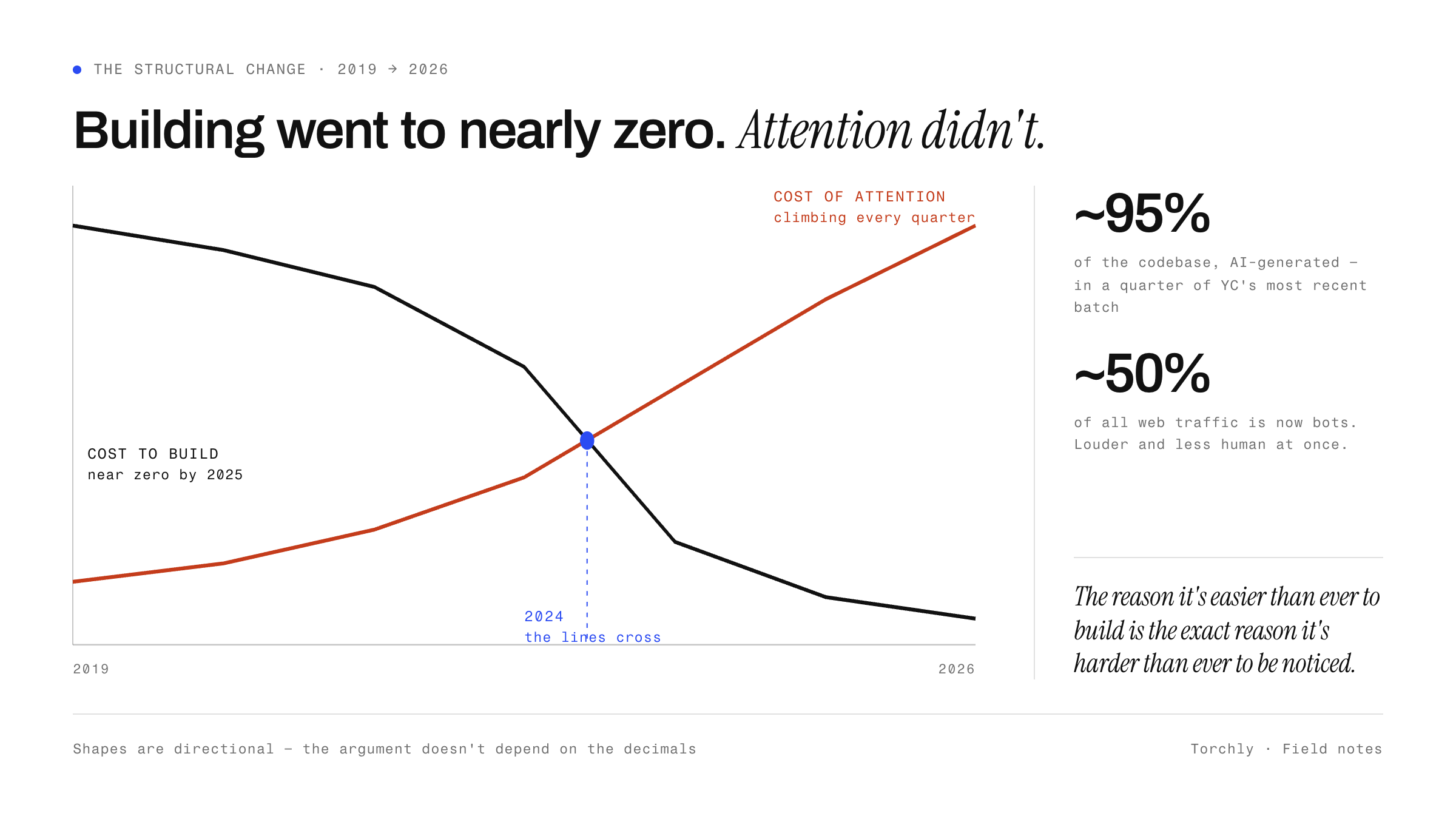
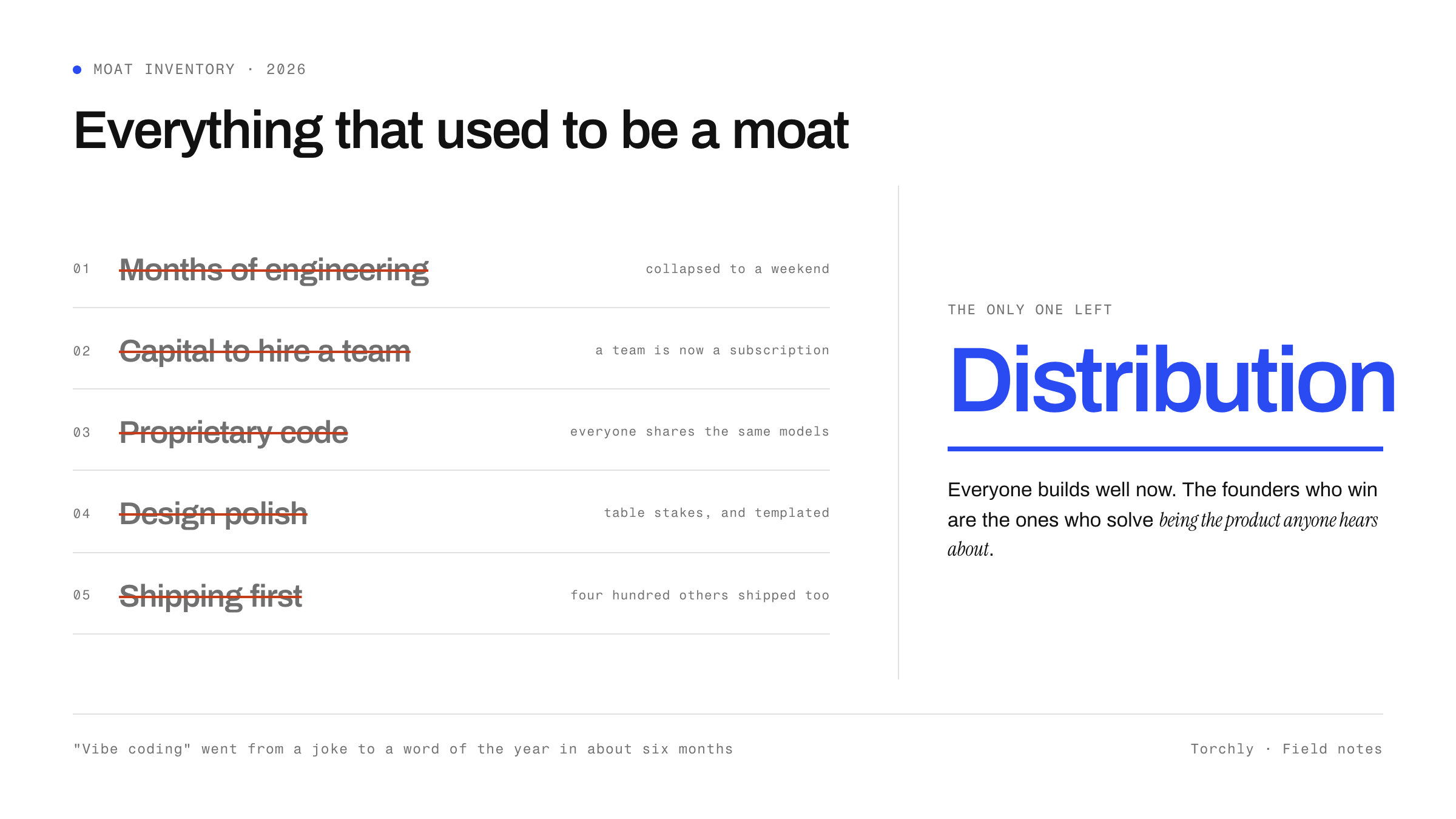
So what's left? Distribution. a16z now argues plainly that in consumer AI, "momentum is the moat" – when anyone can build and everyone shares the same models, the durable edge is adoption, not architecture. Their own Andrew Chen put the uncomfortable half of it out loud: every marketing channel sucks right now. Paid gives you a bump and no retention. SEO takes quarters. The channels didn't get better; they got more crowded, by a flood of new products that were all cheap to build.
That's the trap. The reason it's easier than ever to build is the exact reason it's harder than ever to be noticed.
The playbook assumes you're a performer
The default answer to "how do I get noticed" has quietly become "become a creator." Put your face on everything. And for a specific kind of founder, that works. But founder-led marketing has a burnout problem that everyone who's tried it knows: the assumption that it means becoming an influencer, posting daily, living online. That misunderstanding is where it falls apart. The most common objections founders give aren't laziness – they're "I don't know what to say" and "I'm not a content person."
Those aren't excuses. They're accurate. Most people who are excellent at building are not excellent at performing, and the market has decided that the price of distribution is a performance. That's a bad trade, and a lot of great products are refusing to pay it and dying instead.
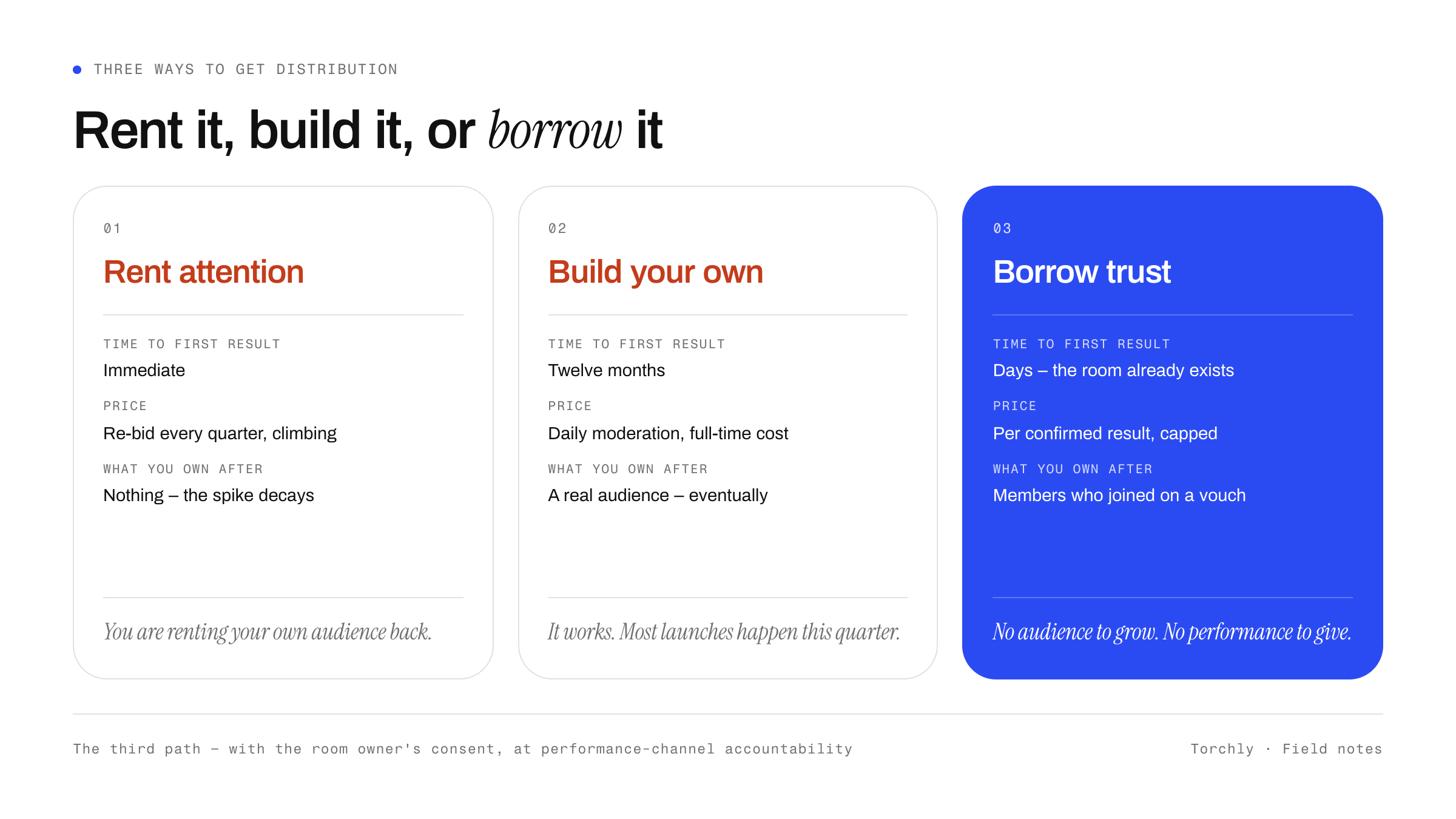
There had to be a third path – one that isn't "rent attention from an algorithm" and isn't "spend a year becoming a personality."
The conversations moved. The trust went with them.
Here's the part the ad industry is slow to admit: the real conversations left the public feed. They happen in private communities now. WhatsApp crossed three billion monthly users this year; Telegram passed a billion. The majority of genuine sharing – the "you have to try this" messages – happens in channels that no marketer can see or measure. Meanwhile, roughly half of all web traffic is now bots. The public internet is getting louder and less human at the same time.
And trust never left. Nielsen has found for years that people trust recommendations from people they know above every other form of advertising – by a wide margin. That trust didn't evaporate; it just concentrated in the rooms where people actually talk. A recommendation from the admin of a community you chose to join does something no ad can do, because it isn't an ad. It's a person you trust, vouching.
That's the asset. It already exists, in tens of thousands of communities, and it is almost completely closed to brands – for good reason, because the fastest way to kill a community is to let it get spammed.
What Torchly actually is
Torchly is the layer that lets a brand borrow that trust without breaking it. A brand writes a brief. We match it to communities whose members actually fit. The admin – the person the room trusts – reviews it and either endorses it in their own voice or declines it. Members click, and every result is tracked per community. The brand pays for confirmed outcomes, not impressions. Roughly one in five proposed briefs gets declined, and we think that's the best feature we have: quality audiences with a veto structure that keeps the channel worth being in.
For the builder who won't become an influencer, that's the point. You don't have to grow an audience. You borrow one that already trusts someone – and you pay only when it works.
And it isn't only for the scrappy. Serious companies and agencies are realising the same thing from the other direction: their buyers are deciding inside these rooms, before they ever hit a website, in a medium their competitors haven't figured out how to enter. The brand that gets there first – endorsed, not intruding – takes share in a place that isn't yet an auction.
We built Torchly for both of them. For my friends with the great products and no appetite for going viral. And for the brands who've noticed the conversation moved and want in, the right way. The cost of building went to zero. We're building the thing that comes next.